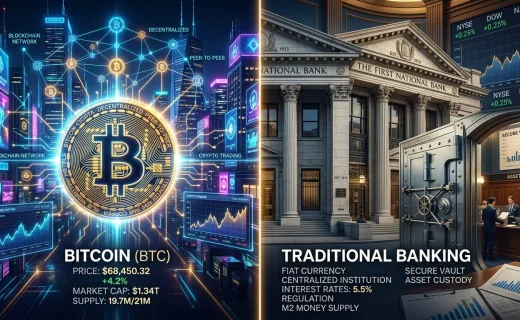
Bitcoin’s price in the last quarter of 2026 is likely to be shaped less by hype than by the collision of liquidity, regulation and institutional positioning. For high-net-worth investors and internationally mobile families, the more relevant question is not whether bitcoin can still deliver outsized upside, but what kind of macro regime will determine its fair value into year-end. In a market now increasingly influenced by spot ETF flows, sovereign policy shifts and cross-border tax scrutiny, bitcoin has become less of a retail-only speculative asset and more of a globally traded liquidity instrument.
Bitcoin price in Q4 2026: the key drivers
The final quarter of 2026 should be assessed through three lenses: monetary conditions, supply dynamics and regulatory clarity. If global interest rates are still easing by then, risk assets could continue to benefit from lower real yields and improved capital allocation. Bitcoin has historically responded positively when dollar liquidity expands and the opportunity cost of holding non-yielding assets falls.
At the same time, bitcoin’s fixed supply schedule remains a structural support. By late 2026, the market will have had more than two years to digest the post-2024 halving effect, with new issuance materially constrained. That matters because any sustained increase in demand, whether from institutions, family offices or treasury allocators, must compete for a relatively rigid float.
Regulation may be even more important than macro. The European Union’s Markets in Crypto-Assets Regulation (MiCA) is already setting a benchmark for licensing, custody standards and market conduct. In the UK, the Financial Conduct Authority continues to tighten expectations around promotions, safeguarding and risk disclosure. In the US, the SEC and CFTC remain central to market structure, especially around custody, derivatives and spot market surveillance. For investors, clearer rules can reduce the “regulatory discount” that has long weighed on bitcoin’s institutional adoption.
Institutional flows remain the decisive variable
For affluent investors, the most important development in bitcoin has been its gradual migration into institutional portfolios. Spot bitcoin ETFs and similar regulated products have lowered operational barriers, making allocation decisions easier for private banks, multi-family offices and discretionary managers. If this trend persists into the last quarter of 2026, price discovery could become less erratic and more flow-driven.
That said, institutional participation cuts both ways. It can amplify upside when allocations rise, but it can also sharpen drawdowns if macro sentiment deteriorates. By Q4 2026, bitcoin may trade more like a liquid macro asset than a standalone crypto narrative. That means payrolls data, the dollar index, Treasury real yields and central-bank guidance may matter as much as blockchain metrics.
What a realistic bitcoin price range could look like
Forecasting bitcoin at a single number for late 2026 is a fraught exercise. A more responsible approach is to consider scenario ranges.
In a constructive macro environment — moderate growth, declining inflation, supportive liquidity and continued ETF inflows — bitcoin could plausibly test a range well above previous cycle highs, potentially between $120,000 and $180,000. This would assume persistent risk appetite, stronger institutional adoption and a relatively benign regulatory backdrop.
In a base case, where growth slows but does not collapse, rates stay higher for longer and adoption continues at a steadier pace, bitcoin may trade in a broad range of roughly $80,000 to $120,000. That would still represent an elevated valuation relative to many historical benchmarks, but one consistent with bitcoin’s increasing market depth.
In a negative scenario — for example, a sharper recession, a renewed liquidity squeeze or disruptive regulation in a major market — bitcoin could revisit materially lower levels, perhaps in the $50,000 to $80,000 zone. Even then, the coin’s role as a scarce digital asset would not disappear, but valuation would likely compress as investors de-risk.
The most important determinant of bitcoin’s late-2026 price may not be adoption alone, but the cost of capital: when liquidity is abundant, scarcity commands a premium.
Why expats and global investors should pay close attention
Expats and internationally diversified investors face a different set of considerations from domestic retail holders. Bitcoin is increasingly part of cross-border wealth planning, but it is also subject to enhanced scrutiny by tax authorities and financial institutions. The OECD’s Crypto-Asset Reporting Framework (CARF) is set to expand automatic exchange of information among jurisdictions, reducing the scope for anonymity and increasing compliance expectations. In parallel, the FATF travel rule continues to shape how virtual asset service providers handle sender and recipient data.
For investors living between jurisdictions, this matters. Bitcoin gains may be taxed differently depending on residence, source rules and local treatment of digital assets. Custody arrangements can also affect estate