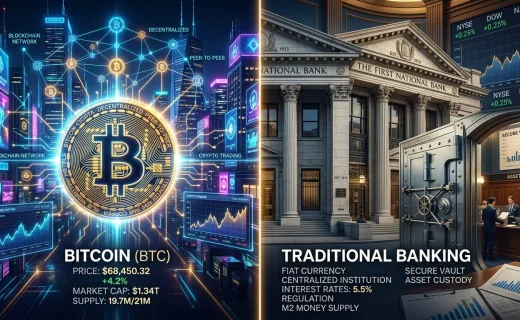
Bitcoin’s price is once again being set by a familiar mix of macro forces, institutional flows and policy risk — but today’s move has a sharper institutional edge than in previous cycles. For high-net-worth investors and globally mobile expats, the key question is not simply whether Bitcoin is up or down, but what is driving the latest repricing in a market that increasingly trades like a cross between a risk asset, a monetary hedge and a liquidity proxy. With ETF demand, real yields, central bank expectations and regulatory scrutiny all pulling in different directions, Bitcoin remains one of the most closely watched assets in global markets.
Bitcoin Today: A Market Trading on Macro, Liquidity and Positioning
Bitcoin’s price action is increasingly shaped by the same forces that move equities, gold and the dollar. When liquidity is abundant, real yields fall and investors expect easier monetary policy, Bitcoin typically benefits. When the Federal Reserve maintains restrictive policy, the dollar strengthens and funding conditions tighten, Bitcoin often comes under pressure.
That pattern matters because Bitcoin is no longer a niche retail trade. It is now embedded in institutional portfolios, family office allocations and exchange-traded fund flows. Spot Bitcoin ETFs in the U.S. have created a new demand channel, bringing regulated access to the asset for wealth managers and allocators who previously stayed on the sidelines. In a market where products must also contend with rules under the U.S. Securities Act of 1933, the Exchange Act of 1934 and evolving Commodity Futures Trading Commission oversight, regulated access itself has become a price catalyst.
The immediate driver of Bitcoin today is therefore not one single headline, but the interaction between ETF inflows, macro expectations and risk appetite.
Why Bitcoin Is Moving: The Main Price Drivers
1. U.S. Interest Rate Expectations
Bitcoin tends to respond strongly to shifts in interest rate expectations. If markets believe the Federal Reserve is moving toward easing, the opportunity cost of holding a non-yielding asset such as Bitcoin declines. Conversely, when inflation proves sticky or labour data stay firm, the market pushes out rate cuts and Bitcoin often softens.
For investors, the practical takeaway is simple: watch U.S. real yields, not just nominal rates. Bitcoin has often tracked the direction of inflation-adjusted Treasury yields more closely than most crypto traders admit.
2. ETF Flows and Institutional Demand
Spot Bitcoin ETFs have changed market structure. Daily creations and redemptions now matter as much as exchange flows once did. When institutions allocate capital through compliant vehicles, demand becomes less speculative and more strategic. That supports deeper liquidity, but it can also intensify momentum when inflows cluster.
From a portfolio perspective, ETF demand provides a cleaner signal than social media sentiment. Sustained inflows suggest Bitcoin is increasingly treated as a strategic diversifier rather than a pure trading instrument.
3. U.S. Dollar Strength
Bitcoin generally moves inversely with the dollar index. A stronger dollar tightens global financial conditions, particularly for expats and international investors whose wealth spans multiple currencies. This is especially relevant for holders measuring returns in sterling, euros, Swiss francs or the UAE dirham.
When the dollar rises, global liquidity often feels tighter. That can weigh on Bitcoin, especially if investors are also unwinding leveraged positions in crypto markets.
4. Regulatory Developments
Regulation remains a major valuation input. In the U.S., the SEC’s stance on digital asset products, custody and exchange compliance continues to influence sentiment. In Europe, the Markets in Crypto-Assets Regulation, or MiCA, has improved clarity for issuers and service providers. In the UK, the Financial Conduct Authority has tightened rules around financial promotions and cryptoasset marketing. In Singapore, the Monetary Authority of Singapore continues to stress licensing and AML/CFT standards. The UAE has also developed a more structured framework through authorities including VARA and ADGM.
These regimes matter because Bitcoin is not traded in a legal vacuum. The more certainty investors have around custody, tax treatment, anti-money laundering controls and cross-border transfer rules, the more comfortable institutional capital becomes.
Bitcoin is increasingly being priced less as a fringe bet and more as a global liquidity instrument whose sensitivity to rates, regulation and ETF flows now rivals that of smaller macro assets.
What High-Net-Worth Investors Should Watch Now
For affluent investors and expats, Bitcoin’s present market setup is best understood through three lenses.
First, watch liquidity. If central banks signal a softer policy stance and bond yields fall, Bitcoin tends to benefit. Second, monitor ETF flows and exchange balances. Falling exchange reserves can indicate supply tightening, which is often supportive for price. Third, assess policy risk in your own jurisdiction. Tax residency, reporting obligations and custody standards