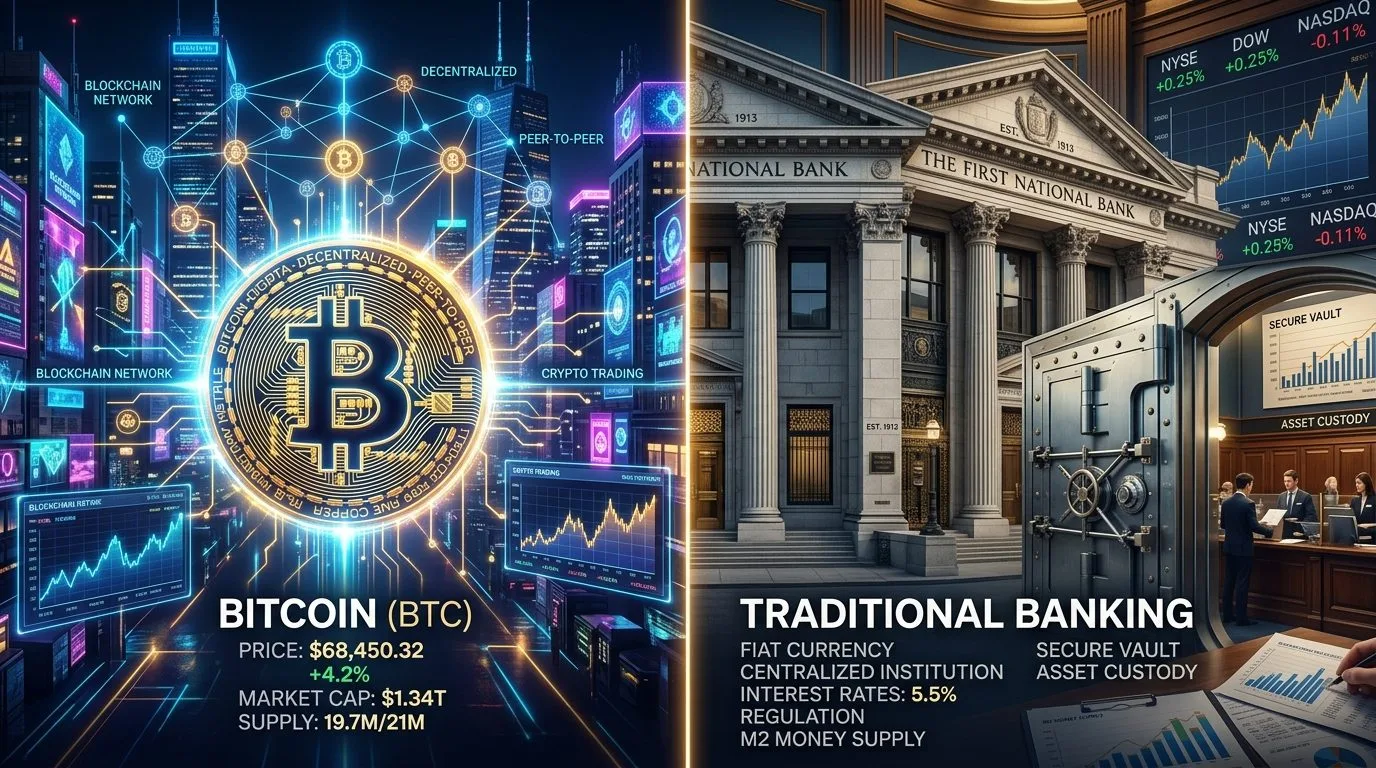
Bitcoin vs Traditional Banking: Who Wins in 2026? The Battle for Financial Control
In 2026, the financial world stands at a defining crossroads where two fundamentally different systems are competing for dominance. On one side is Bitcoin, a decentralized digital asset designed to operate outside traditional financial institutions. On the other side is the global banking system, a well-established network of regulated institutions that has managed the flow of money for centuries. The question of which system will prevail is no longer theoretical; it is shaping real-world decisions for individuals, businesses, and governments around the globe.
This confrontation is not simply about technology or ideology. It is about control, efficiency, trust, and the future of financial power. As both systems evolve, they are influencing each other in unexpected ways, creating a hybrid landscape that is redefining what banking means in the modern era.
The Rise of Bitcoin as a Financial Alternative
Bitcoin’s rise has been driven by its promise of decentralization and independence from traditional financial systems. It offers users the ability to hold and transfer value without relying on intermediaries such as banks. In 2026, this feature is more relevant than ever as individuals seek greater control over their finances in an increasingly digital world.
The narrative of Bitcoin as digital gold has strengthened, particularly in regions experiencing economic instability or currency devaluation. Its fixed supply and transparent monetary policy provide a level of predictability that contrasts sharply with fiat currencies. As adoption continues to grow, Bitcoin is becoming a legitimate alternative for storing and transferring wealth.
How Traditional Banking Still Dominates
Despite the rise of Bitcoin, traditional banking remains a dominant force in the global financial system. Banks provide a wide range of services, including lending, credit, wealth management, and regulatory compliance, that are essential for economic stability. In 2026, banks continue to play a central role in facilitating large-scale financial transactions and supporting global commerce.
One of the key strengths of traditional banking is its integration with governments and regulatory frameworks. This relationship provides a level of security and trust that is difficult for decentralized systems to replicate. For many users, the assurance of regulatory oversight and consumer protection is a critical factor in choosing banks over alternative systems.
Control and Ownership: Who Holds Your Money
The question of control is at the heart of the Bitcoin versus traditional banking debate. With Bitcoin, users have direct ownership of their assets through private keys. This means they are fully responsible for managing and securing their funds. While this provides unparalleled autonomy, it also requires a higher level of technical understanding and responsibility.
In contrast, traditional banks act as custodians of their customers’ funds. While this reduces the burden on individuals, it also means that users must trust banks to manage their money responsibly. Issues such as account freezes, withdrawal limits, and third-party control highlight the trade-offs involved in this model.
Speed and Efficiency in Transactions
Speed and efficiency are critical factors in modern finance. Bitcoin transactions can be processed globally without the need for intermediaries, making them faster and more accessible in certain contexts. However, network congestion and transaction fees can impact performance, particularly during periods of high demand.
Traditional banks, on the other hand, have made significant advancements in digital payments and real-time processing. While cross-border transactions can still be slow and expensive, innovations such as instant payment systems are improving efficiency. The competition between these systems is driving continuous improvement on both sides.
Costs and Fees: Bitcoin vs Banks
Cost is another important consideration in the comparison between Bitcoin and traditional banking. Bitcoin transactions can offer lower fees, particularly for cross-border transfers. However, fees can fluctuate based on network activity, creating uncertainty for users.
Banks typically charge fixed fees for services such as transfers, account maintenance, and currency conversion. While these fees can be higher, they are often more predictable. For businesses and individuals, the choice between these systems often depends on their specific financial needs and usage patterns.
Security and Trust in Both Systems
Security is a critical factor in any financial system. Bitcoin relies on cryptographic technology and decentralized networks to ensure the integrity of transactions. This makes it highly resistant to fraud and tampering. However, the responsibility for securing funds lies entirely with the user, which can be a challenge for those unfamiliar with digital security practices.
Traditional banks invest heavily in security measures and fraud prevention systems. They also provide protections such as insurance and dispute resolution mechanisms. This institutional support can offer peace of mind, particularly for users who prefer a more managed approach to financial security.
Regulation and Compliance Challenges
Regulation is a major area of difference between Bitcoin and traditional banking. Banks operate within strict regulatory frameworks that govern their activities and ensure compliance with financial laws. This provides stability but can also limit flexibility and innovation.
Bitcoin operates in a more decentralized and less regulated environment. While this allows for greater freedom, it also raises concerns about compliance, taxation, and legal oversight. In 2026, governments are working to establish clearer regulations for cryptocurrencies, which could significantly impact their adoption and use.
Adoption Trends in 2026
Adoption trends in 2026 reveal a growing convergence between Bitcoin and traditional banking. More individuals and businesses are using Bitcoin for payments, investments, and savings. At the same time, banks are integrating cryptocurrency services into their offerings, bridging the gap between the two systems.
This convergence suggests that the future of finance may not be a winner-takes-all scenario. Instead, it is likely to involve a combination of decentralized and centralized systems working together to meet diverse financial needs.
The Role of Institutions and Governments
Institutions and governments play a crucial role in shaping the outcome of this competition. Their policies and actions can influence the adoption and development of both Bitcoin and traditional banking. In 2026, many governments are exploring digital currencies and blockchain technology, while also seeking to regulate cryptocurrencies.
The involvement of institutions adds credibility to Bitcoin but also introduces new complexities. As more traditional players enter the space, the lines between decentralized and centralized finance continue to blur.
The Future: Coexistence or Disruption
The question of whether Bitcoin or traditional banking will win in 2026 does not have a simple answer. Both systems have unique strengths and weaknesses, and their interaction is shaping a new financial landscape. Rather than one replacing the other, it is increasingly likely that they will coexist, each serving different purposes.
Bitcoin represents innovation, independence, and a shift toward decentralized finance. Traditional banking offers stability, trust, and comprehensive financial services. Together, they are creating a hybrid system that combines the best of both worlds.
As the financial industry continues to evolve, the focus will be on integration and collaboration rather than competition alone. For users, this means more choices and greater flexibility in managing their finances. For the industry, it represents an opportunity to redefine what banking can be in a digital age.
Ultimately, the winner in this battle may not be Bitcoin or traditional banking alone, but the users who benefit from a more dynamic and inclusive financial system. In 2026, the future of finance is not about choosing sides; it is about embracing change and leveraging the strengths of both systems.