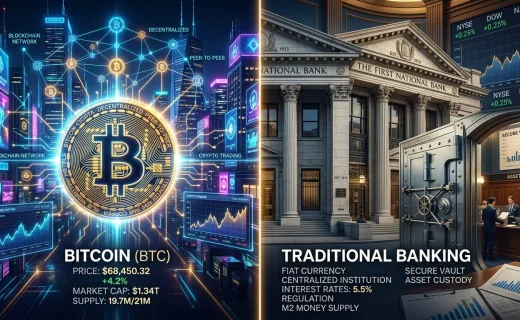
DeFi 3.0: The Merge Between Global Banks and Decentralized Liquidity Networks
The financial world is entering a new phase of evolution—one that goes far beyond the early days of cryptocurrency and decentralized finance. This next stage, often referred to as DeFi 3.0, represents the convergence of two previously opposing forces: traditional global banking and decentralized liquidity networks. What was once seen as a disruptive threat to the banking system is now becoming a strategic partnership that could redefine how capital flows across the world.
In the coming years, the lines between centralized and decentralized finance will blur. Banks will no longer operate in isolation, and decentralized platforms will no longer exist outside the regulatory framework. Instead, a hybrid system will emerge, combining the stability and trust of traditional institutions with the efficiency and innovation of blockchain-based networks.
The Evolution from DeFi 1.0 to DeFi 3.0
To understand DeFi 3.0, it is important to look at the evolution of decentralized finance. DeFi 1.0 focused on basic financial services such as lending, borrowing, and trading, all conducted on blockchain networks without intermediaries. While revolutionary, this phase was limited by scalability issues, lack of regulation, and user complexity.
DeFi 2.0 introduced improvements in liquidity management, yield optimization, and protocol efficiency. It aimed to address some of the shortcomings of the first phase by enhancing the sustainability of decentralized ecosystems. However, it still operated largely independently from traditional financial systems.
DeFi 3.0 marks a significant shift. Instead of competing with banks, decentralized finance is integrating with them. This integration creates a more robust and scalable system, capable of supporting global financial operations while maintaining the transparency and efficiency of blockchain technology.
Why Global Banks Are Entering DeFi
Global banks are increasingly recognizing the potential of decentralized finance. The efficiency, speed, and cost-effectiveness of blockchain-based systems offer significant advantages over traditional processes. Transactions that once took days can now be completed in seconds, with lower fees and greater transparency.
By entering the DeFi space, banks can access new sources of liquidity and expand their service offerings. They can provide clients with innovative financial products, such as tokenized assets, decentralized lending, and real-time settlement solutions. This not only enhances their competitiveness but also opens up new revenue streams.
Moreover, regulatory frameworks are evolving to accommodate this integration. Governments and financial authorities are beginning to establish guidelines that allow banks to interact with decentralized networks in a compliant manner. This creates a foundation for collaboration rather than competition.
As a result, many financial institutions are investing heavily in blockchain technology and forming partnerships with DeFi platforms. This trend is expected to accelerate as the benefits of integration become more apparent.
The Power of Decentralized Liquidity Networks
Decentralized liquidity networks are at the heart of DeFi 3.0. These networks enable the seamless movement of capital across different platforms and markets, without the need for traditional intermediaries. By pooling liquidity from a global user base, they create a more efficient and accessible financial system.
One of the key advantages of decentralized liquidity is its flexibility. Unlike traditional banking systems, which are often constrained by geographic and regulatory boundaries, decentralized networks operate on a global scale. This allows capital to flow freely, enabling faster and more efficient transactions.
In a DeFi 3.0 environment, banks can tap into these liquidity pools to enhance their operations. For example, they can use decentralized networks to source funding, manage risk, and execute transactions more efficiently. This creates a symbiotic relationship where both banks and decentralized platforms benefit from each other’s strengths.
The integration of decentralized liquidity also enhances financial inclusion. By removing barriers to entry, it allows individuals and businesses around the world to access financial services that were previously unavailable to them.
Smart Contracts, AI, and Hybrid Finance
The technological foundation of DeFi 3.0 lies in the combination of smart contracts, artificial intelligence, and hybrid financial systems. Smart contracts automate the execution of agreements, ensuring that transactions are carried out according to predefined conditions. This reduces the need for manual intervention and minimizes the risk of errors.
Artificial intelligence adds another layer of sophistication. AI systems can analyze market data, assess risk, and optimize financial strategies in real time. This enables more efficient decision-making and enhances the overall performance of the system.
Hybrid finance, often referred to as “CeDeFi” (Centralized-Decentralized Finance), represents the blending of traditional and decentralized models. In this system, banks provide the infrastructure and regulatory compliance, while decentralized networks offer liquidity and innovation. The result is a more balanced and resilient financial ecosystem.
This integration also paves the way for new financial products and services. For instance, tokenized assets can be traded on decentralized platforms while being backed by traditional financial institutions. This creates a bridge between the old and new financial systems.
The Future of Global Finance in a DeFi 3.0 World
The emergence of DeFi 3.0 is set to transform the global financial landscape. As banks and decentralized networks continue to integrate, the efficiency and accessibility of financial services will improve significantly. Transactions will become faster, cheaper, and more transparent, benefiting both individuals and businesses.
In the next five years, we can expect to see widespread adoption of hybrid financial models. Banks will increasingly incorporate decentralized technologies into their operations, while DeFi platforms will align more closely with regulatory requirements. This convergence will create a more unified and efficient financial system.
For investors, DeFi 3.0 offers new opportunities to access global markets and diversify their portfolios. The ability to interact with both traditional and decentralized systems provides greater flexibility and control over investments.
However, this transformation also comes with challenges. Issues related to security, regulation, and interoperability must be addressed to ensure the stability of the system. As the financial landscape becomes more complex, collaboration between stakeholders will be essential.
Despite these challenges, the potential of DeFi 3.0 is immense. By combining the strengths of global banks and decentralized liquidity networks, it creates a powerful new framework for financial innovation. This hybrid system has the potential to redefine how capital is managed, distributed, and utilized across the world.
Ultimately, DeFi 3.0 represents more than just a technological advancement—it is a paradigm shift in the way finance operates. As this new system continues to evolve, it will shape the future of global finance, creating opportunities for growth, innovation, and inclusion on an unprecedented scale.