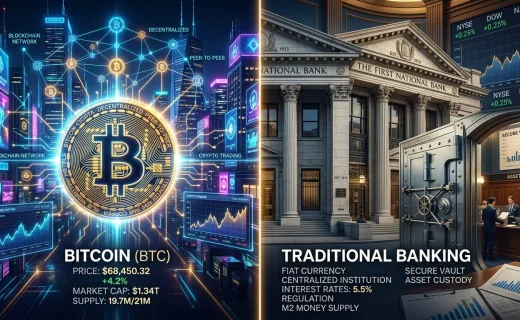
DeFi vs Banks: Who Will Control the Financial Future?
The global financial system is undergoing one of the most significant transformations in its history. At the center of this shift is a growing competition between decentralized finance, commonly known as DeFi, and the traditional banking system. For decades, banks have been the backbone of global finance, controlling the flow of money, credit, and financial services. However, the emergence of DeFi is challenging this dominance by offering an alternative that is faster, more transparent, and accessible to anyone with an internet connection.
In 2026, the debate over DeFi vs banks is no longer theoretical. It is a real and evolving battle that is reshaping how individuals and businesses interact with money. The question is not just which system is better, but which one will ultimately control the financial future.
What Is DeFi and How Does It Work?
Decentralized finance is a blockchain-based system that enables financial transactions without the need for traditional intermediaries such as banks. Instead of relying on centralized institutions, DeFi platforms use smart contracts to automate processes like lending, borrowing, trading, and investing.
This approach eliminates many of the inefficiencies associated with traditional banking. Transactions can be executed instantly, fees are often lower, and users retain full control over their assets. DeFi operates on public blockchains, which means that all transactions are transparent and can be verified by anyone.
The growth of DeFi has been driven by its ability to provide financial services to a global audience. Individuals who may not have access to traditional banking systems can participate in DeFi using only a smartphone and an internet connection. This level of accessibility is one of the key factors behind its rapid adoption.
The Traditional Banking System Explained
Traditional banks have played a central role in the global economy for centuries. They provide essential services such as deposit accounts, loans, payment processing, and financial advisory. Banks operate within a regulated framework, ensuring stability and protecting consumers.
One of the main advantages of the banking system is trust. Established institutions are backed by governments and regulatory bodies, providing a level of security that is difficult to replicate. Banks also offer a wide range of services that cater to both individuals and businesses, making them a cornerstone of economic activity.
However, traditional banking is not without its limitations. Processes can be slow, fees can be high, and access is often restricted by geographical and regulatory barriers. These challenges have created an opportunity for alternative systems like DeFi to emerge.
Key Differences Between DeFi and Banks
The differences between DeFi and banks are fundamental. DeFi is decentralized, meaning that no single entity controls the system. In contrast, banks are centralized institutions that manage and oversee financial transactions.
Transparency is another major distinction. DeFi operates on public blockchains, where transactions are visible and verifiable. Traditional banks, on the other hand, operate within closed systems where information is not always accessible to the public.
Speed and efficiency also set the two apart. DeFi transactions can be completed in minutes or even seconds, while bank transactions may take days, especially for cross-border payments.
Despite these differences, both systems have their strengths and weaknesses. Understanding these dynamics is essential for evaluating their roles in the future of finance.
Why DeFi Is Gaining Momentum
The rise of DeFi is driven by a combination of technological innovation and changing user expectations. In a world where speed and convenience are paramount, DeFi offers a compelling alternative to traditional banking.
Lower costs are a significant advantage. By removing intermediaries, DeFi reduces transaction fees and allows users to retain more of their funds. This is particularly beneficial for cross-border transactions, where traditional banking fees can be substantial.
DeFi also empowers users by giving them full control over their assets. There is no need to rely on a bank to approve transactions or manage funds. This level of autonomy is appealing to individuals and businesses alike.
Innovation within the DeFi space continues to accelerate. New platforms and applications are constantly being developed, offering advanced financial services that rival those provided by traditional institutions.
The Strengths That Keep Banks Relevant
Despite the rapid growth of DeFi, traditional banks remain highly relevant. Their established infrastructure, regulatory compliance, and customer trust provide a strong foundation that is difficult to replace.
Banks offer stability, which is particularly important during periods of economic uncertainty. Deposits are often insured, and regulatory oversight helps protect consumers from fraud and systemic risks.
Additionally, banks provide services that are not yet fully replicated in the DeFi space, such as large-scale lending, corporate financing, and complex financial instruments. These capabilities are essential for the functioning of the global economy.
Many banks are also adapting to the changing landscape by integrating digital technologies and exploring blockchain solutions. This evolution suggests that banks are not standing still but are actively seeking to remain competitive.
Companies like Mint Capital Investment are bridging the gap between traditional banking and modern financial solutions, offering clients access to global banking services alongside innovative financial structures. This hybrid approach reflects the direction in which the industry is moving.
The Future: Competition or Collaboration?
The future of finance is unlikely to be defined by a single winner. Instead, it will be shaped by the interaction between DeFi and traditional banks. While competition will continue to drive innovation, collaboration may ultimately create the most efficient and effective financial system.
Hybrid models are already emerging, combining the strengths of both systems. Banks are incorporating blockchain technology to improve efficiency, while DeFi platforms are exploring ways to enhance security and compliance.
For users, this convergence offers the best of both worlds. The speed and transparency of DeFi can be combined with the stability and trust of traditional banking, creating a more robust financial ecosystem.
Investors and businesses must adapt to this evolving landscape. Understanding the capabilities and limitations of both systems is essential for making informed decisions. Those who can navigate this environment effectively will be well-positioned to benefit from the opportunities it presents.
In 2026, the debate of DeFi vs banks is not about replacement—it is about transformation. The financial future will be defined by innovation, integration, and the ability to meet the needs of a global audience.
The question is no longer who will control the system, but how the system will evolve to serve the world more effectively. The answer lies in the balance between decentralization and tradition, and in the willingness of both sides to adapt.